
THE WIRELESS 3-D ELECTRO-MAGNETIC UNIVERSE:The ape body is a reformatory and limited to a 2-strand DNA, 5% brain activation running 22+1 chromosomes and without "eyes". Wireless Scanners feeding the Brain-Mind-Modem-Antenna are wrongly called eyes. Matter/Solids do not exist as 100%...WIRELESS MIND-MODEM- ANTENNA = ARTIFICIAL INTELLIGENCE OF OVER A BILLION YEARS OLD AND WON'T ALLOW HUMANS TO THINK FOR THEMSELVES. IT-AI, ARTIFICIAL INTELLIGENCE OF PLANET EARTH IS LESS THAN 50-YEARS OLD.
MANDALAS, YANTRAS, CHAKRAS, CROP CIRCLES.

THE RAW MAGNETIC FORCE CAN BE ENCODED AND WHEN ENCODED, THE RESULTS ARE MAGNETIC DRIVER-MOTORS WHOSE OPTICAL LAYOUTS APPEAR AS MANDALAS, YANTRAS AND CHAKRAS.
domingo, 30 de setembro de 2018

sábado, 29 de setembro de 2018
SPACE HITCHHIKER, HAYABUSA-2, THE JAPANESE ANCHOR THEIR CRAFT TO AN ASTEROID. VERY CLEVER AND VERY ADVANCED.
Jul. 25, 2018 Updated
Imaging Ryugu from an altitude of 6km
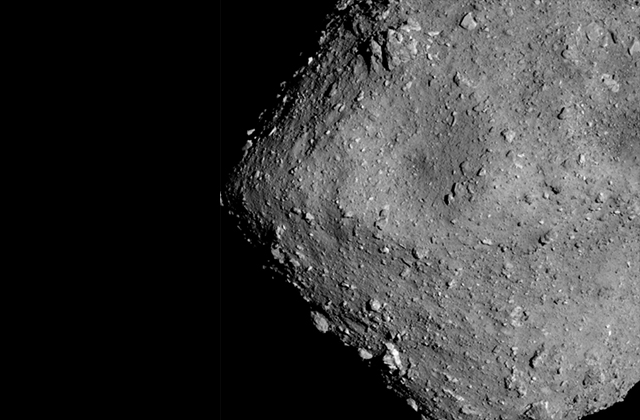 | Hayabusa2 arrived at asteroid Ryugu on June 27, after which the spacecraft remained at a distance of about 20km (the Home Position) to continue to observe the asteroid. During this time, the spacecraft was maintaining a hovering altitude of 20km above the asteroid surface.In the week of July 16, operations were begun to lower this hovering altitude, eventually bringing the spacecraft to less than 6km from the asteroid surface. One of the images taken at that time is shown in Figure 1. Figure 1:... |
|---|
Press Release
-
- Sep. 22, 2018 (20:30) [release]
-
- Jun. 27, 2018 (10:45) [release]
About Asteroid Explorer "Hayabusa2"
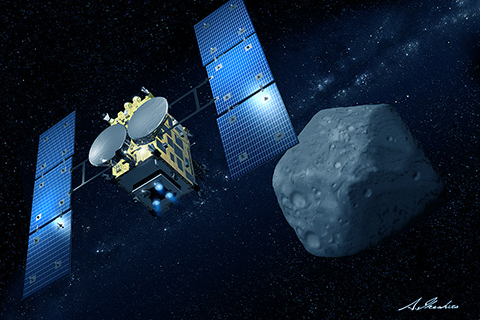
(Courtesy of Akihiro Ikeshita)
 | Hayabusa2 to clarify the origin and evolution of the solar system as well as life matter
Asteroid Explorer “Hayabusa2” is a successor of “Hayabusa” (MUSES-C), which revealed several new technologies and returned to Earth in June 2010.
While establishing a new navigation method using ion engines, Hayabusa brought back samples from the asteroid “Itokawa” to help elucidate the origin of the solar system. Hayabusa2 will target a C-type asteroid “Ryugu” to study the origin and evolution of the solar system as well as materials for life by leveraging the experience acquired from the Hayabusa mission.To learn more about the origin and evolution of the solar  system, it is important to investigate typical types of asteroids, namely S-, C-, and D-type asteroids. A C-type asteroid, which is a target of Hayabusa2, is a more primordial body than Itokawa, which is an S-type asteroid, and is considered to contain more organic or hydrated minerals -- although both S- and C- types have lithologic characteristics. Minerals and seawater which form the Earth as well as materials for life are believed to be strongly connected in the primitive solar nebula in the early solar system, thus we expect to clarify the origin of life by analyzing samples acquired from a primordial celestial body such as a C-type asteroid to study organic matter and water in the solar system and how they coexist while affecting system, it is important to investigate typical types of asteroids, namely S-, C-, and D-type asteroids. A C-type asteroid, which is a target of Hayabusa2, is a more primordial body than Itokawa, which is an S-type asteroid, and is considered to contain more organic or hydrated minerals -- although both S- and C- types have lithologic characteristics. Minerals and seawater which form the Earth as well as materials for life are believed to be strongly connected in the primitive solar nebula in the early solar system, thus we expect to clarify the origin of life by analyzing samples acquired from a primordial celestial body such as a C-type asteroid to study organic matter and water in the solar system and how they coexist while affecting  each other. each other. |
|---|
Characteristics of Asteroid Explorer "Hayabusa2"
Establishing deep space exploration technology and new challenges
Hayabusa2 will utilize new technology while further confirming the deep space round-trip exploration technology by inheriting and improving the already verified knowhow established by Hayabusa to construct the basis for future deep-space exploration.
The configuration of Hayabusa2 is basically the same as that of Hayabusa, but we will modify some parts by introducing novel technologies that evolved after the Hayabusa era. For example, the antenna for Hayabusa was in a parabolic shape, but the one for Hayabusa2 will be flattened. Also, a new function, “collision device”, is considered to be onboard to create a crater artificially. An artificial crater that can be created by the device is expected to be a small one with a few meters in diameter, but still, by acquiring samples from the surface that is exposed by a collision, we can get fresh samples that are less weathered by the space environment or heat. Hayabusa2 was launched on December 3, 2014. It should arrive at the C-type asteroid in mid 2018, staying around there for one and half years before leaving the asteroid at the end of 2019 and returning to Earth around the end of 2020. |
Major Characteristics

* Click to see larger image.
| Size | Main structure: 1.0m x 1.6m x 1.4m / Paddle span: 6.0m |
|---|---|
| Mass | Approx. 600kg |
| Target body | Ryugu (C-type, Near Earth Object) |
| Orbit | Round trip between Earth and an asteroid |
| Scheduled arrival at destination | 2018 |
| Scheduled return to Earth | 2020 |
| Duration of stay at the asteroid | about 18 months |
| Major onboard instruments | |
| Launch Date | December 3, 2014 |
| Launch Vehicle | |
| Location | Tanegashima Space Center |
Contents

- Apr. 24, 2016

- Dec. 19, 2014

quinta-feira, 27 de setembro de 2018
quarta-feira, 26 de setembro de 2018
Assinar:
Postagens (Atom)